





















How to separate the funnel: forms, calls, chats — and not lose attribution in Google Ads?
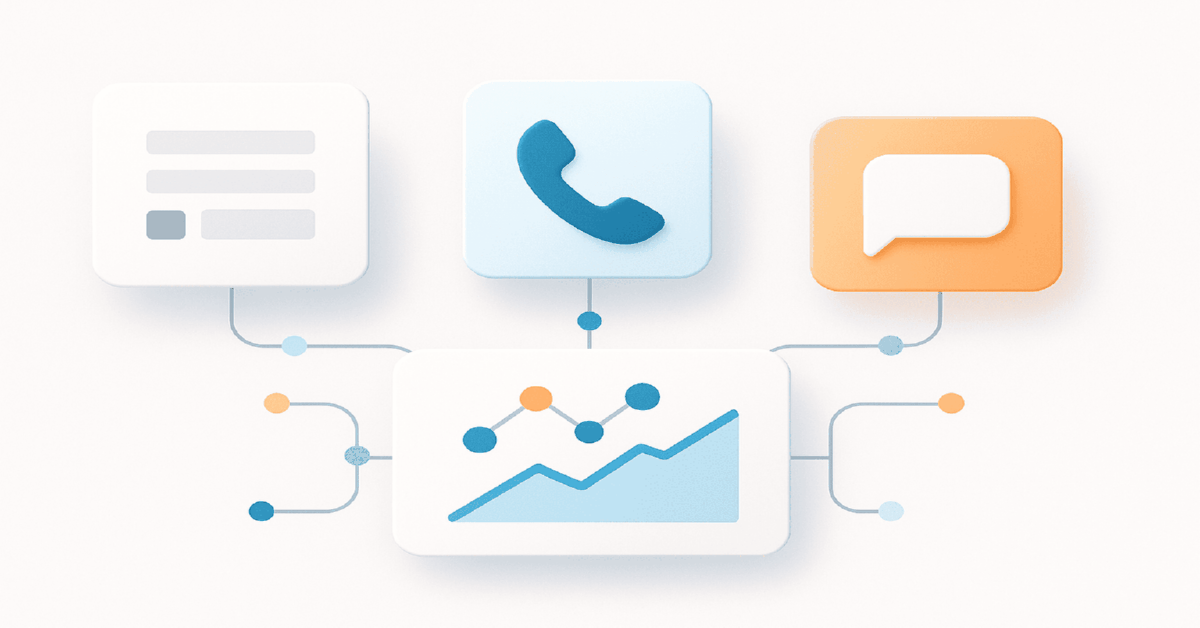


Summary:
- Channel-based funnel separation: forms, calls and chats tracked as distinct conversions → clear user paths → accurate revenue attribution.
- Why mixed conversions fail: a single goal blurs signals, preventing Google Ads from learning which contact method drives outcomes.
- Attribution in 2026: deterministic identifiers, server-side event capture and CRM offline conversions replace fragile cookie-based tracking.
- Data backbone: one click_id connects click, contact event, CRM lead status and sale across time and devices.
- Per-channel conversion setup: form_submit, call_connected, chat_started / chat_qualified with aligned parameters and CRM mapping.
- Learning quality control: strict deduplication, call and chat thresholds, cohort checks for missing keys, lag and duplicates.
Definition
Separating funnels by contact method is an attribution and optimization approach where forms, phone calls and chats are tracked as independent conversions sharing the same identifiers. In practice, events are captured server-side, linked to CRM records and uploaded to Google Ads by lifecycle stage. This structure trains bidding strategies on qualified intent and revenue rather than blended micro-actions.
Table Of Contents
- Why separate funnels for forms calls and chats
- What changes in attribution in 2026 and why it matters
- How to define a conversion for each contact channel
- Data model that survives redirects widgets and long sales cycles
- Google Ads GA4 and CRM integration without dead ends
- UTM click ids and naming discipline
- Offline conversions that teach bidding on real revenue
- Live chat and messengers without attribution leakage
- Quality control with cohort views
- Under the hood of robust attribution
- SMB and enterprise patterns compared
- Checklist before you scale bidding on value
Why separate funnels for forms calls and chats
Splitting your funnel by contact method gives transparent attribution and cleaner optimization signals. When Google Ads sees distinct conversions for form submissions, phone calls and live chats, bid strategies learn what actually drives revenue instead of averaging unlike actions into a noisy target.
The practice is simple in intent and strict in execution. Each touchpoint emits its own event, uses the same deterministic click key and maps to the same CRM record. From impression to click to lead to sale, the data grain does not change names, which prevents orphaned conversions and model drift.
If you’re just getting into this ecosystem and want the bigger picture first, it’s worth starting with a solid primer on how media buying in Google Ads actually works end to end. Once you understand that foundation, separating funnels for forms, calls and chats becomes a straightforward structural decision, not a theory exercise.
What changes in attribution in 2026 and why it matters
With privacy constraints and cookie loss, reliable measurement depends on server side capture and offline conversions. Client identifiers coexist with click identifiers, and CRM status changes are streamed back to Google Ads. This keeps Smart Bidding grounded in business outcomes instead of proxy signals.
The backbone remains consistent across stacks. A persistent click_id such as gclid gbraid or wbraid, a stable client_id from GA4 and a single CRM lead_id travel together. When statuses move from new to qualified to won, the same keys are echoed so deduplication is deterministic. For a step by step walkthrough of this process, see the guide on setting up offline conversions and wiring CRM sales back into Google Ads.
How to define a conversion for each contact channel
Create separate GA4 events and separate Google Ads conversions, then align parameters across them. For forms, confirm form_submit on server acknowledgement rather than button clicks. For calls, record call_connected with duration and caller number from dynamic number insertion. For chats, track chat_started and later chat_qualified when an agent verifies intent. Each event must include click_id client_id session_id landing_page campaign and content.
This separation prevents a form heavy ad group from diluting a call focused objective, and allows you to hold different CPA or value per conversion while keeping cross channel comparability in reporting.
Data model that survives redirects widgets and long sales cycles
A minimal schema links ad click keys to CRM objects and timestamps so paths can be rebuilt weeks later regardless of device hops. The fewer mutable fields you have the safer the pipeline under release pressure.
| Field | Purpose | Example |
|---|---|---|
| click_id | Deterministic join between click and lead | gclid EAIaIQobChMI12... |
| client_id | Anonymous GA4 identity | GA4 1837429 5521 |
| event_type | Contact method | form_submit call_connected chat_started |
| event_timestamp | When the event occurred | 2026 10 29T10 41 05Z |
| crm_lead_id | Lead or deal id | L 938271 |
| lead_status | Lifecycle marker | new qualified won lost |
| value currency | Monetary signal | 25900 00 RUB |
Once this backbone is in place, it becomes much easier to evaluate which search terms and auction segments actually move pipeline. For a deeper dive into using the search network specifically as a traffic engine, check out this breakdown on using Google Search as a core channel for media buying.
Google Ads GA4 and CRM integration without dead ends
Use GA4 import for online actions and send offline conversions directly to Google Ads for calls and CRM sales. This hybrid protects measurement when browsers limit client storage and keeps training windows populated even with long lag to revenue.
On site capture correct parameters and preserve click ids through redirects. In analytics deduplicate and keep naming invariant. In CRM store the mapping of click_id to lead_id and emit status updates with consistent timestamps. Stability of keys beats sophistication of dashboards when something breaks.
Deduplication in 2026: avoid double counting when GA4 and CRM both feed Google Ads
If you import online conversions from GA4 and also send offline conversions from your CRM to Google Ads, the #1 failure mode is a duplicated signal for the same lead. The fix is to define a strict single source of truth per funnel stage and keep it stable across releases.
A practical pattern is stage separation: lead is recorded once (for example form_submit or call_connected), while qualified and won are always sent only as offline conversions from the CRM. This prevents Smart Bidding from learning on noise and protects conversion value from inflation.
| Stage | Source of truth | Dedup key | Do not do this |
|---|---|---|---|
| lead | GA4 or server | click_id plus event_timestamp | send the same lead again from CRM |
| qualified | CRM | click_id plus crm_lead_id | upload without a stored click_id |
| won | CRM | click_id plus deal_id | rewrite click_id after the fact |
UTM click ids and naming discipline
Attribution quality starts at URL hygiene. Persist gclid gbraid and wbraid exactly as received. Do not rewrite them in the browser. Keep a single UTM taxonomy for source medium campaign content and term. If you use a backup ext_click_id generate it once at first touch and never change it. All widgets and forms must echo the same identifiers on submit.
| Parameter | Origin | Role | Rule |
|---|---|---|---|
| gclid gbraid wbraid | Google Ads | Primary click key | Persist as is across domains |
| utm source medium campaign content term | Tagging | Human readable context | One naming standard no Cyrillic |
| client_id session_id | GA4 | Session stitching | Mirror in server side pipeline |
Timestamp discipline: conversion_time rules that prevent silent misattribution
Offline conversions work only if timestamps are treated as first class data. The most common hidden bug is uploading the upload time instead of the event time. That shifts conversions across days, breaks cohort analysis, and makes campaigns look worse or better than they are.
Operational rules: use the exact moment the event happened as conversion_time, always send the correct time_zone, and keep event_timestamp in the CRM immutable. For late backfills, upload with the original event time and the same click_id, never generate a new key. If you change the attribution window or rename conversions, do it as a controlled migration with a parallel period, otherwise trend lines become unusable.
Quality incidents to treat as measurement failures, not auction volatility: rising leads without click_id, spikes in direct none inside the CRM, and a persistent gap between on site leads and Google Ads conversions. When these appear, pause scaling and debug the pipe before touching bids.
Offline conversions that teach bidding on real revenue
Offline conversions close the gap between contact and outcome. For calls send a lead event when connection exceeds your threshold and later send a sale event with the same click_id and value when the deal closes. For CRM deals echo at least qualified and won with accurate conversion_time and time_zone. Never create a new key for enriched updates.
This pattern allows Maximize conversion value or Target ROAS to learn from downstream money rather than cheap micro actions and reduces strategy oscillation during scale. If you’re fighting with spammy submissions or suspicious spikes in traffic while doing this, the article on handling low quality leads and suspicious search activity in Google Ads campaigns will help you clean the signals before they hit your bidding.
Stage value mapping: how to price qualified vs won without breaking tROAS
Most value based bidding failures are not tracking issues, they are value design issues. If you only upload won, the signal is rare and delayed. If you overvalue qualified, the model starts buying cheap pseudo value and CPA drifts.
A stable approach is stage mapping: lead carries value 0, qualified carries a fixed fraction of average revenue, and won carries actual revenue. Keep the qualified fraction unchanged for at least two to four weeks so learning does not reset every time your sales team has a good day.
| Conversion | Meaning | value | When to send |
|---|---|---|---|
| lead | Contact happened | 0 | immediately at event time |
| qualified | Intent confirmed | 0.2 to 0.3 of avg revenue | after CRM qualification |
| won | Money captured | actual revenue | at deal close |
Advice from npprteam.shop: if your order value is volatile, do not guess value on lead. Use lead for volume monitoring and push value only on qualified and won for cleaner learning.
Quality gates for learning: calls and chats must be filtered conversions
Google Ads learns from whatever you label as a conversion. If call_connected includes five second misdials or chat_started includes any hello message, you feed the system low intent data and bidding shifts toward cheap but empty contacts.
Set engineering thresholds. For calls, gate by duration and status: keep call_connected only above a defined duration threshold, then create call_qualified from CRM when an agent confirms intent. For chat, separate activity from intent: keep chat_started for analytics, but send chat_qualified to Ads with click_id and value. This reduces CPA on real pipeline and stabilizes Maximize conversion value for longer sales cycles.
Advice from npprteam.shop: if you are unsure what should be a conversion, choose the event your sales team would sign off as buying intent, not just contact happened.
Live chat and messengers without attribution leakage
Third party widgets often drop parameters. Use a server proxy that injects and reads click_id. Log chat_view on widget open chat_started on first message and chat_qualified when an agent confirms intent. When the dialog moves to a messenger carry the token in the deep link and store it on the contact record for later offline upload.
With deterministic tokens chats become first class citizens in reporting and you can allocate creative and keyword budgets to conversations that actually convert to pipeline.
Advice from npprteam.shop: do not train one bid strategy on mixed signals. Warm up each conversion type separately then switch to Maximize conversion value with only the events that correlate with revenue.
Quality control with cohort views
Weekly cohort checks reveal silent failures. Track the share of leads without click_id per contact method the median lag from click to contact to qualification to sale and the share of duplicates by key. If the no key rate exceeds five to seven percent inspect redirects chat SDKs and form handlers before touching bids.
Holdouts by landing page and campaign expose where parameters get lost. Fix at the server boundary not with brittle browser patches that disappear on the next widget update.
Advice from npprteam.shop: if your sales cycle is long assign interim value to qualified leads such as a fraction of average LTV and include currency. This keeps the learning loop alive while deals mature.
Under the hood of robust attribution
Durability rests on four pillars. Deterministic click to lead joins cut orphaned records compared with UTMs alone. Server side confirmation reduces drop from heavy client widgets. Deduplication by key and timestamp prevents double sends during retries. Invariant field names allow you to ship new landing pages and chat vendors without rebreaking history.
Teams that document the schema and forbid ad hoc renames scale faster because monitoring alerts point to one place. The opposite culture forces analysts to reconcile columns every release and slowly erodes trust in reporting.
SMB and enterprise patterns compared
Company size shapes tooling but not principles. Smaller teams win with GA4 dynamic number insertion a chat widget that echoes click_id and a daily offline upload through CSV or a simple API. Larger stacks add server side GTM an event gateway two way CRM API and a cascade of keys from gclid to backup click_id to user_id plus automated data quality alerts.
| Criterion | SMB approach | Enterprise approach |
|---|---|---|
| Event capture | GA4 client plus basic server confirm | Server side GTM with custom gateway |
| Attribution keys | gclid gbraid wbraid with UTMs | Cascade primary click_id then backup then user_id |
| CRM sync | Daily batch export | Near real time stream and backfill |
| Bidding signals | Separate conversions by contact method | Stage based values and LTV factors |
Advice from npprteam.shop: tools will not fix naming chaos. A one page contract for field names parameters and statuses between marketing analytics and engineering saves months of trial and error.
Checklist before you scale bidding on value
Run a cold rehearsal. Generate a test click with a unique marker complete a form start a call start a chat and push a test deal to won. In reporting you should see four events tied by the same click_id and distinct event_types. GA4 must deduplicate and Google Ads must accept the offline echoes without creating new conversions. Only then move budgets and enable value based strategies.
When the pipeline is this consistent the system learns from real conversations and revenue. Media buying decisions become grounded in which creative keyword and audience drive the right contact method at the right cost not just any interaction that looks like a win in the interface. And if you notice that, despite clean attribution, your P&L is bleeding, it’s worth revisiting this playbook on what to do when Google Ads campaigns consistently lose money before scaling further.
For those who prefer to isolate experiments from their main infrastructure, one practical route is to run tests on separate profiles. On npprteam.shop you can buy ready Google Ads accounts and use them as sandboxes for new structures, creatives and attribution setups without risking your core assets.

The basics of email marketing: how does a channel work and why does a business need it?
Email marketing in 2026: quick market snapshotEmail marketing in 2026 is still one of the most predictable owned channels a...

Computer Vision: detection, segmentation, OCR, multimodal models
Computer Vision for Media Buying in 2026: What Actually Moves MetricsIn 2026, computer vision is less about "cool models" and...

How to check an account before purchasing: checklist for library, VAC/blocks, trade restrictions, regions, email/phone links, and activity history
Why you should verify an account before buying it even if the library looks perfectA game account is not just...


