





















The Logic of Building a Funnel in Email Marketing: Warmup, Offer, Retention, Repeat Sales
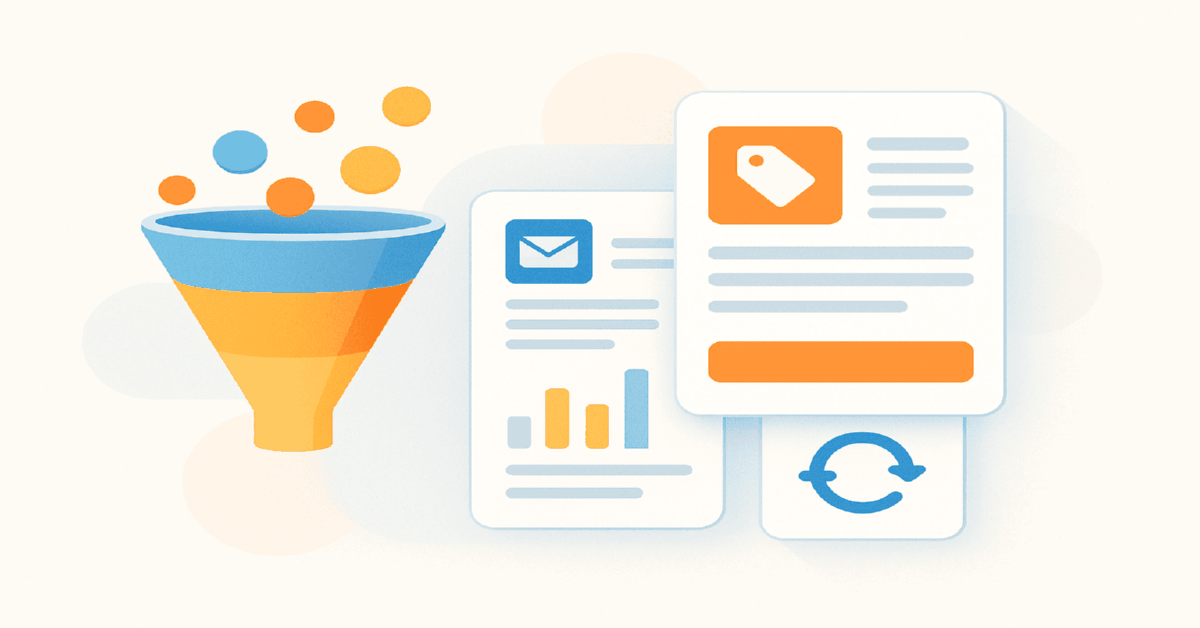


Table Of Contents
Updated: April 2026
TL;DR: An email funnel isn't a sequence of random emails — it's a staged system where each phase (warmup, offer, retention, re-engagement) has distinct metrics and goals. According to Omnisend, automated email sequences represent just 2% of sends but drive 30% of total email revenue — 16x more per send than broadcasts. If you need email accounts ready for funnel deployment right now — browse email accounts at npprteam.shop.
| ✅ This guide is for you if | ❌ Not for you if |
|---|---|
| You have a subscriber list but no structured funnel | You haven't collected any email subscribers yet |
| You send broadcast emails but want automated sequences | You need help with deliverability first — read our spam avoidance guide |
| You want to increase repeat purchases through email | You're looking for cold outreach tactics — this is about opt-in funnels |
An email marketingfunnel moves subscribers through four stages: warmup (building trust), offer (first conversion), retention (keeping them engaged), and repeat sales (maximizing LTV). Each stage requires different content, different timing, and different success metrics. Most marketers skip straight to the offer stage — that's why their funnels break. According to DMA and Litmus, email marketing returns $36-40 for every $1 spent. For e-commerce, Omnisend reports $76 per $1. But those returns only happen when the funnel architecture is right.
What Changed in Email Funnels in 2026
- Automated sequences now drive 30% of email revenue from just 2% of total sends — 16x more revenue per email than broadcasts (Omnisend, 2025)
- Apple MPP and Gmail pre-loading made Open Rate unreliable — funnel optimization now focuses on CTOR (6.81% average per ActiveCampaign) and conversion rate instead
- Gmail transformer spam filters require genuine personalization in every funnel stage — templated "Day 1, Day 3, Day 7" sequences get flagged if they look mass-produced
- SPF + DKIM + DMARC are mandatory — any funnel built on unauthenticated domains will never reach the inbox
- Cold email response rate is 4.0-4.5% (Instantly, 2026) — significantly lower than opt-in funnel CTR, making proper warmup sequences critical for ROI
Stage 1: Warmup — Building Trust Before Selling
The warmup stage is where most funnels fail. Marketers want to sell immediately after someone subscribes. But subscribers who receive a sales email within 24 hours of opt-in have 3x higher unsubscribe rates than those who receive value-first content.
The Welcome Sequence (Emails 1-3)
Email 1 — Immediate (within 5 minutes of opt-in): - Deliver the promised lead magnet - Set expectations: what they'll receive, how often - One sentence about who you are — not a company bio - No sales pitch whatsoever
Email 2 — Day 2: - Share one genuinely useful insight related to the lead magnet topic - Position yourself as someone who does this work, not just writes about it - Ask a question that encourages a reply (reply = positive engagement signal for deliverability)
Related: Warming Up a Domain and IP for Email: How to Do It Right and Why It's Critical
Email 3 — Day 4: - Case study or real-world example - Introduce the problem your product solves — still no pitch - Subtle segmentation: "Click the link that matches your situation" (links to different interest categories)
Case: Info product creator, selling a $297 Facebook Ads course. Problem: Sending sales emails immediately after lead magnet download. Conversion rate: 0.8%. Unsubscribe rate per email: 2.1%. Action: Built a 5-email warmup sequence over 10 days. Emails 1-3 delivered pure value (ad audit checklist, case study, common mistakes guide). Email 4 introduced the course. Email 5 was the sales push with deadline. Result: Conversion rate increased to 3.4%. Unsubscribe rate dropped to 0.4%. Revenue per subscriber increased 4.2x.
Domain Warmup vs. Content Warmup
Don't confuse content warmup (trust-building with subscribers) with domain warmup (building sender reputation). Both matter, but they operate independently.
Domain warmup timeline (Instantly/Mailpool, 2025):
| Week | Emails/Day | Focus |
|---|---|---|
| 1 | 5-10 | Send to engaged contacts only, get replies |
| 2 | 20-30 | Expand to larger segments |
| 3-4 | 50-100 | Scale while maintaining engagement |
| 5+ | 100+/inbox | Full capacity, 3-5 inboxes per domain |
⚠️ Important: If you're launching a new emailfunnel on a fresh domain, you need 2-4 weeks of domain warmup before your funnel emails even reach subscribers. Sending your beautifully crafted welcome sequence from an unwarmed domain means it goes straight to spam. Plan your launch timeline accordingly.
Stage 2: Offer — The First Conversion
The offer stage begins after your warmup sequence has delivered value and earned attention. Timing depends on your product price point and sales cycle.
Offer Timing by Product Type
| Product Type | Price | Warmup Length | Offer Window |
|---|---|---|---|
| Low-ticket digital ($7-47) | Low | 3-5 emails | Email 4-6 |
| Mid-ticket course ($97-497) | Medium | 5-7 emails | Email 6-8 |
| High-ticket service ($1000+) | High | 7-10 emails | Email 8-12 |
| SaaS free trial | Free start | 2-3 emails | Email 3-4 |
| E-commerce first purchase | Variable | 2-4 emails | Email 3-5 |
The Sales Sequence (Emails 4-7)
Email 4 — The Bridge: - Connect the problem you've been discussing to your solution - Present the product naturally — "Here's what I built to solve this" - Include social proof (testimonials, numbers, case results) - Single CTA — one link, one action
Email 5 — Objection Handling: - Address the #1 objection directly - FAQ format works well: "You might be wondering..." - Another testimonial from someone who had the same objection
Related: Email Marketing Basics: How the Channel Works and Why Your Business Can't Ignore It
Email 6 — Urgency (if applicable): - Genuine scarcity or deadline — not fake countdown timers - Recap the key benefits - Direct comparison: cost of the problem vs. cost of the solution
Email 7 — Last Chance: - Short, direct, honest - "The offer closes tonight" — only if it actually does - Link to the page with no additional content
Need multiple email accounts for A/B testing funnel sequences? Check Outlook accounts and Yahoo accounts at npprteam.shop — test different sender identities to optimize your funnel's deliverability. 95% instant delivery.
Measuring Offer Stage Success
Don't measure the offer stage by Open Rate — it's unreliable since Apple MPP. Focus on:
- CTOR per email: Target 8-12% for sales emails (above the 6.81% average)
- Click-to-purchase conversion: 5-15% for low-ticket, 2-5% for high-ticket
- Revenue per email sent: The north-star metric for the offer stage
- Unsubscribe rate per email: Should stay below 0.5% — if higher, your warmup was insufficient
Stage 3: Retention — Keeping Subscribers Engaged
After the first sale (or for those who didn't buy), the retention stage keeps your list warm and productive. This is where most email programs die — they stop sending or switch to pure sales mode.
The Post-Purchase Sequence
Email 1 (Day 0): Order confirmation + what to expect next Email 2 (Day 3): "How's it going?" — ask about their experience Email 3 (Day 7): Share a tip that makes the product more valuable Email 4 (Day 14): Ask for a review or testimonial Email 5 (Day 30): Cross-sell or upsell related product
The Non-Buyer Nurture Sequence
For subscribers who went through your offer stage but didn't purchase:
Related: Creating Warming-Up Chains: From Welcome Series to Retention Scenarios
- Don't immediately pitch again — they said no for a reason
- Return to value mode — share 2-3 pure content emails
- Re-segment by engagement — if they're still clicking, they're interested
- Re-pitch with a different angle — different positioning, different social proof
- Sunset after 60 days of zero engagement — remove completely unengaged subscribers
⚠️ Important: Keeping unengaged subscribers on your list actively hurts you. They drag down your engagement metrics, which tells Gmail to demote your emails for everyone. Aggressive list pruning (removing anyone who hasn't opened/clicked in 90 days) typically improves overall deliverability by 15-25%.
Content Mix for Retention
| Content Type | Frequency | Purpose |
|---|---|---|
| Educational content | 60% of emails | Maintain perceived value |
| Case studies / stories | 20% of emails | Build trust and aspiration |
| Promotional / sales | 15% of emails | Generate revenue |
| Surveys / engagement | 5% of emails | Segment and learn |
Case: E-commerce brand, health supplements, 22,000-subscriber list. Problem: After initial welcome + offer sequence, sent only promotional emails. List engagement dropped 40% in 3 months. Unsubscribes averaged 0.8% per send. Action: Implemented 60/20/15/5 content mix. Created a "Supplement Science" weekly series (educational). Added monthly customer spotlight (story). Reduced promotional sends from 4x/week to 1x/week. Result: CTR increased from 1.4% to 3.2%. Unsubscribe rate dropped to 0.2%. Revenue actually increased 18% despite fewer promotional emails — because engagement metrics improved deliverability.
Stage 4: Repeat Sales — Maximizing Customer Lifetime Value
The repeat sales stage targets existing customers with upsells, cross-sells, and re-purchase triggers. This is where email ROI compounds — acquiring a new subscriber costs 5-7x more than selling to an existing one.
Automated Re-Purchase Triggers
For products with predictable consumption cycles (supplements, consumables, subscriptions):
- Usage-based: "Your 30-day supply runs out in 5 days — reorder here"
- Behavior-based: "You viewed [product] 3 times — here's 10% off your first order"
- Milestone-based: "You've been a customer for 6 months — here's your loyalty reward"
Win-Back Sequence for Lapsed Customers
When a customer hasn't purchased in 2-3x their normal purchase cycle:
Email 1: "We miss you" — no sales pitch, just acknowledge the gap Email 2: Share what's new since they last purchased Email 3: Exclusive offer — genuine discount, not fake urgency Email 4: "Is this goodbye?" — final email before sunsetting from active list
Revenue Attribution by Funnel Stage
| Stage | % of Email Revenue | Key Metric |
|---|---|---|
| Welcome/Warmup | 5-10% | Engagement rate, reply rate |
| First Offer | 25-35% | Conversion rate, revenue per email |
| Retention | 15-25% | Click rate, content consumption |
| Repeat Sales | 30-45% | LTV, repeat purchase rate |
The highest revenue concentration is in repeat sales — but it only works if stages 1-3 were executed properly. Skipping to repeat sales without warmup and retention is like asking someone to marry you on the first date.
Scaling your funnel across multiple sending domains? Browse ProtonMail accounts and Mail.ru accounts at npprteam.shop — diversify your sender infrastructure to maximize inbox placement across the funnel. We've fulfilled 250,000+ orders since 2019.
Quick Start Checklist
- [ ] Map your funnel stages: warmup → offer → retention → repeat sales
- [ ] Build a 3-5 email welcome sequence before any sales content
- [ ] Set up domain authentication (SPF + DKIM + DMARC) before launching
- [ ] Warm new domains for 2-4 weeks before sending funnel emails
- [ ] Create automated sequences for each funnel stage
- [ ] Maintain 60/20/15/5 content mix in retention phase
- [ ] Set up re-purchase triggers for consumable products
- [ ] Sunset unengaged subscribers after 90 days of zero interaction
- [ ] Track CTOR and revenue per email as primary metrics — not Open Rate
Ready to deploy your email funnel on reliable infrastructure? Explore the full email account catalog at npprteam.shop — 1,000+ account types, instant delivery, support in 5-10 minutes.
What to Read Next

Embeddings and Vector Search: Semantic Representations and Similarity Search
Updated: April 2026 TL;DR: Embeddings convert text, images, and code into numerical vectors that capture meaning — enabling AI to find...

Ad Analytics on Bulletin Boards: Views, CTR, Responses, Conversion, and Simple A/B Testing
Updated: April 2026 TL;DR: Most classified sellers never look at their ad analytics — and leave 40-60% of potential sales on...

Facebook Ads CBO (Campaign Budget Optimization): How It Works & When to Use It
TL;DR: CBO (Campaign Budget Optimization) lets Facebook automatically allocate your budget across ad sets, putting more spend toward whichever ad...


