





















The Mechanics of Chargebacks and Refunds: How Rollbacks Create Risks for Keys, Gifts, and Accounts
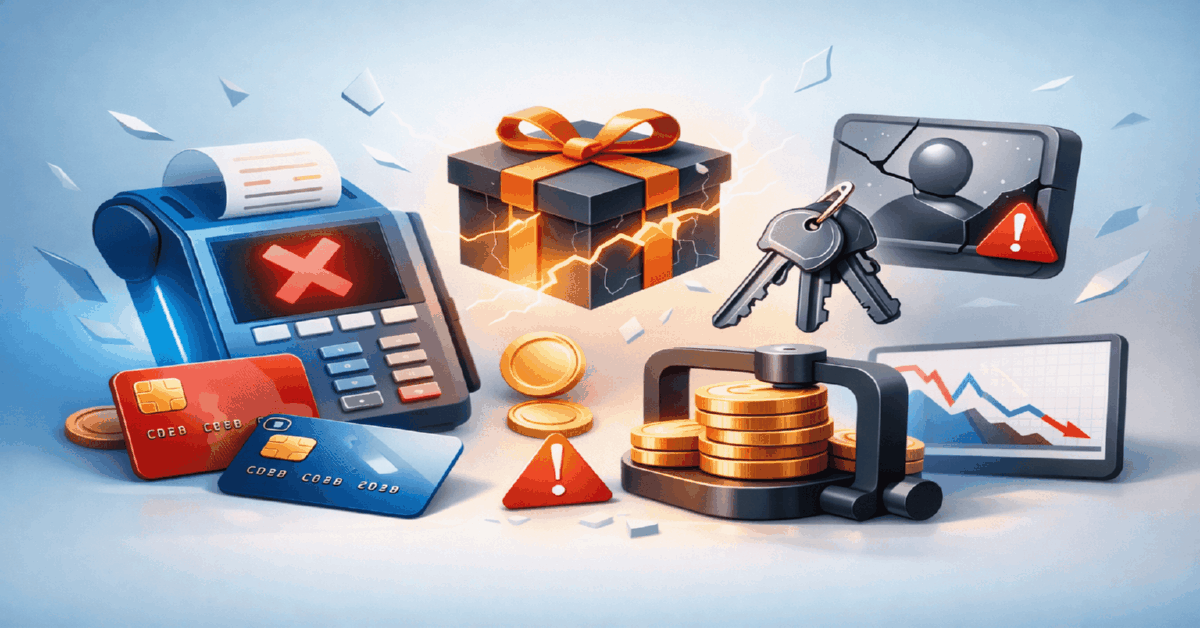


Table Of Contents
- What Changed in Chargebacks and Refunds in 2026
- How Chargebacks Work in the Gaming Ecosystem
- Platform Refund Policies: What Gets Reversed and What Stays
- The Ripple Effect: How One Chargeback Damages Multiple Parties
- How to Protect Yourself from Chargeback Risk
- Refund Fraud: When Buyers Abuse the System
- Quick Start Checklist
- What to Read Next
TL;DR: Chargebacks and refunds are the biggest hidden risk in digital game commerce. A single chargeback can revoke keys, strip inventories, and ban accounts permanently. Steam processes billions in transactions across 132-147 million MAU (SteamDB, 2025) — and chargeback fraud accounts for significant losses industry-wide. If you need verified accounts from a trusted source right now — browse the catalog with 1-hour replacement guarantee.
| ✅ Right for you if | ❌ Not for you if |
|---|---|
| You buy keys, gifts, or accounts on secondary markets | You only buy games from official stores |
| You want to understand why keys get revoked | You have never encountered a chargeback issue |
| You resell digital goods and need to manage risk | You do not deal with payment processing |
A chargeback occurs when a buyer disputes a credit card transaction with their bank, forcing the merchant to refund the payment. In gaming, chargebacks trigger a cascade: the payment is reversed, the purchased item (key, gift, or account content) is revoked by the platform, and the end user — who may be an innocent buyer on a secondary market — loses everything.
What Changed in Chargebacks and Refunds in 2026
- Steam increased automated fraud detection — accounts with chargeback history now face permanent marketplace bans within 24 hours
- Visa and Mastercard raised chargeback fees to $25-100 per dispute for merchants, incentivizing stricter seller verification
- Epic Games Store implemented stricter refund limits: 2-hour playtime / 14-day window
- Battle.net expanded its purchase protection to include automatic review of high-frequency gift purchases
- Steam's refund policy remained unchanged: under 2 hours of play + under 14 days since purchase
How Chargebacks Work in the Gaming Ecosystem
The chargeback chain
- Original buyer purchases a game key, gift, or in-game items using a credit card
- Original buyer sells the key/gift on a secondary market
- End buyer receives and activates the key or gift
- Original buyer files a chargeback with their bank (claiming fraud, unauthorized purchase, etc.)
- Bank reverses the payment to the platform (Steam, Epic, etc.)
- Platform revokes the purchased content from all downstream recipients
- End buyer loses the game, items, or entire account access
The critical insight: the end buyer did nothing wrong, but they bear the consequences. This is why the source of keys and gifts matters more than the price.
Case: A reseller bought 50 Steam keys using a stolen credit card, listed them at 60% below retail on a grey marketplace, and sold all 50 within 3 days. Two weeks later, Valve processed the chargeback. All 50 keys were revoked from the end buyers' accounts. 50 people lost their games with no recourse. Problem: Cheap keys from unknown sources carry chargeback risk that is invisible at purchase time. Result: The reseller disappeared. The marketplace offered no guarantees. The end buyers learned that price is not the only variable.
⚠️ Important: When buying keys or gifts from secondary sources, always verify the seller's track record and guarantee policy. A key that is 70% cheaper may have been purchased with stolen payment methods — and revocation can happen weeks or months after activation.
Need keys and accounts from a verified marketplace? Browse game keys and Steam accounts at npprteam.shop — every product guaranteed working at time of sale, 1-hour replacement window.
Platform Refund Policies: What Gets Reversed and What Stays
Steam refund rules
| Condition | Refund Available? | Time Limit |
|---|---|---|
| Under 2 hours playtime + under 14 days | Yes (automatic) | 14 days |
| Over 2 hours playtime | Generally no | — |
| DLC (if base game played 2+ hours) | Generally no | — |
| In-game purchases | Within 48 hours | 48 hours |
| Gifts (unredeemed) | Yes | 14 days |
| Gifts (redeemed + under 2 hours) | Yes | 14 days |
| Subscriptions | Pro-rated in some cases | Varies |
Steam's refund system is automated for straightforward cases. Abuse of refunds (systematic refund-and-rebuy patterns) results in restricted refund access.
Epic Games Store refund rules
- Under 2 hours of runtime AND within 14 days of purchase
- One-click self-service refunds
- Tighter enforcement against serial refunders since 2025
Battle.net refund rules
- Most digital purchases can be refunded within 14 days if not used
- WoW game time: non-refundable after consumption
- Character services: non-refundable after use
- Gift purchases: refundable only if recipient has not redeemed
How refunds differ from chargebacks
| Feature | Refund | Chargeback |
|---|---|---|
| Initiated by | Buyer through platform | Buyer through bank |
| Platform awareness | Yes — controlled process | Yes — but involuntary |
| Account impact | None (if within policy) | Account ban, marketplace restriction |
| Content revocation | Immediate and clean | Immediate + collateral damage |
| Seller impact | Normal cost of business | Fee + fraud flag + possible termination |
The Ripple Effect: How One Chargeback Damages Multiple Parties
A single chargeback does not exist in isolation. It creates a chain reaction:
Impact on the end buyer
- Game or item removed from library
- No refund from platform (they already refunded the original buyer's bank)
- Possible account standing damage if multiple revoked items exist
Impact on the secondary market seller
- Reputation damage
- Financial loss (sold product at a loss)
- Potential platform ban if using the same account
Impact on the platform
- Payment processing fee ($15-25 per chargeback to Visa/Mastercard)
- Increased fraud monitoring costs
- Higher risk rating from payment processors
⚠️ Important: Platforms like Steam permanently ban accounts that initiate chargebacks. The ban affects all games, inventory, wallet funds, and marketplace access. A chargeback on a $10 game can result in losing a $10,000 account. This is why refunds through official channels are always preferable.
How to Protect Yourself from Chargeback Risk
As a buyer on secondary markets
- Buy from reputable sources — marketplaces with guarantee policies, not random forum sellers
- Verify seller history — check reviews, account age, and transaction volume
- Avoid suspiciously low prices — 70%+ discounts on new releases are a red flag
- Keep transaction records — screenshots, payment receipts, chat logs
- Activate keys immediately — delayed activation does not prevent revocation, but faster activation means faster discovery of issues
As a seller
- Know your suppliers — verify the source of keys and accounts
- Use chargeback-protected payment methods — crypto, pre-paid balances
- Monitor for revoked keys — check your sold keys periodically
- Offer guarantees — replacement policies build trust and reduce disputes
Case: A buyer consistently purchased game keys from two sources: a grey marketplace (average discount 65%) and npprteam.shop (average discount 30%). Over 6 months: 4 out of 20 grey-market keys were revoked (20% failure rate). Zero out of 15 keys from npprteam.shop were revoked. Action: Switched entirely to npprteam.shop for key purchases. Result: $0 lost to revocations. The slightly higher per-key cost was offset by zero losses and no time wasted on disputes.
Refund Fraud: When Buyers Abuse the System
Refund fraud is the mirror image of chargeback fraud. Instead of disputing with the bank, the buyer:
- Purchases a game
- Plays extensively (using methods to keep recorded playtime under 2 hours)
- Requests a refund
- Keeps any in-game progress, items, or knowledge gained
Platforms are fighting this with: - Playtime tracking improvements — detecting time manipulation - Pattern recognition — flagging accounts with excessive refund rates - Restricted refund access — reducing future refund availability for repeat abusers
Need verified accounts and keys with no chargeback risk? Browse the full game accounts catalog at npprteam.shop — 250,000+ orders fulfilled, support available in 5-10 minutes.
Quick Start Checklist
- [ ] Only buy keys and gifts from sources with replacement guarantees
- [ ] Never file a chargeback on a gaming platform — use the official refund process
- [ ] Keep all purchase records (receipts, chat logs, screenshots)
- [ ] Activate keys immediately after purchase to detect issues early
- [ ] Avoid prices that seem too good to be true (70%+ off new releases)
- [ ] Check seller reputation and transaction history before purchasing
- [ ] Understand that key revocation can happen weeks after activation
What to Read Next
- Source verification: Secondary Markets and Digital Product Provenance
- Anti-fraud: Anti-Fraud in Digital Distribution
- Safe purchasing: How to Check a Game Account Before Buying
- Disputes: Digital Game Disputes: Causes and Resolution

Image and Video Formats in Twitter Ads: Requirements, Specs, and Life Hacks
TL;DR: Getting image and video specs wrong in X/Twitter Ads means wasted budget on cropped visuals and rejected creatives. X...

Reddit AMAs and Research Posts in 2026: How to Start and Sustain Discussion That Drives Traffic
TL;DR: AMAs and research-style posts are the highest-engagement formats on Reddit — top AMAs generate 500-2000+ comments. The key is...

Rare and Collectible Games: How to Find, Compare, and Safely Buy Delisted Titles, Legacy Editions, and Bundles on Steam, EGS, and Other Launchers
TL;DR: Delisted games, legacy editions, and discontinued bundles are the digital equivalent of out-of-print books — once they are gone...


