





















The history of digital game distribution: from discs to libraries in launchers and marketplaces
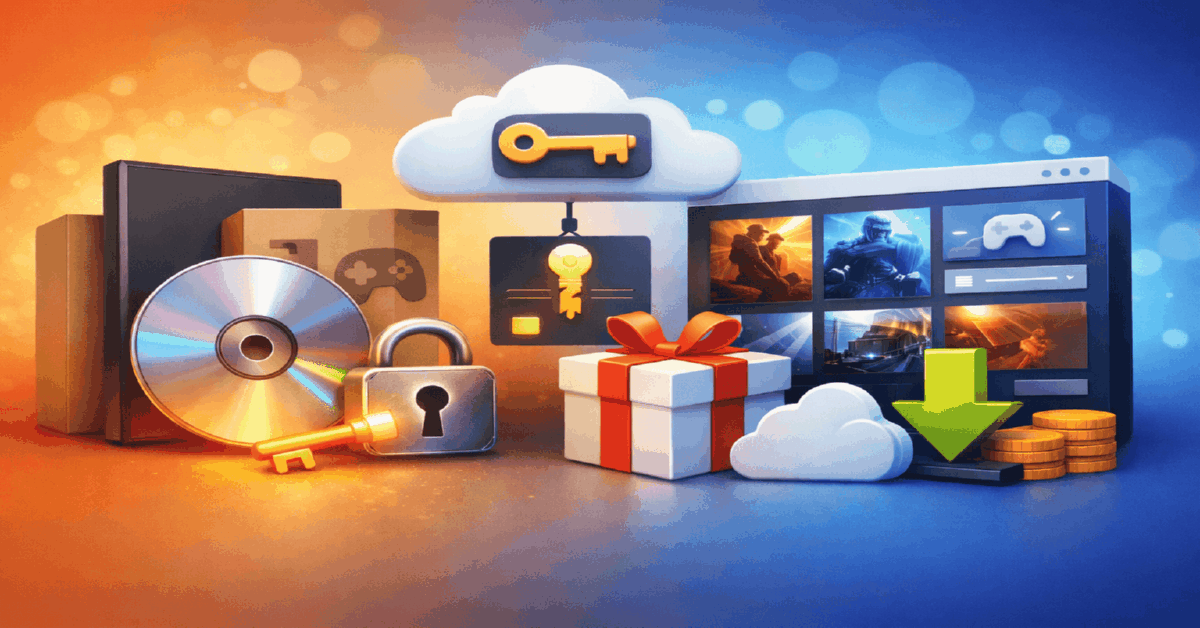


Summary:
- Digital distribution is framed as infrastructure: licensing, account access, builds/patches, payments, refunds, regional policy, and algorithmic discovery.
- The disc era solved slow internet and sold certainty, but imposed logistics, inventory risk, and low post-launch agility for fixes.
- Bridge years introduced activation keys, gifts, and DRM: ownership shifted to account-based entitlements and unlocked measurable behavior signals.
- Launchers turned updates into controlled workflows (integrity checks, incremental patching, branches, rollback) and made libraries a retention anchor.
- Storefronts became strategic channels: featuring, wishlists, seasonal promos, reviews, moderation, and refund rules reshape conversion and outcomes.
- By 2026, subscriptions/cloud play push "access over ownership," while Russia/CIS adds payment and regional friction across the full journey.
Definition
Digital game distribution is an end-to-end system that grants an account-bound license, delivers content and patches, enforces regional and refund policies, and shapes demand through storefront algorithms. In practice, teams map and instrument the full loop—discovery → payment → entitlement → installation → first launch → refunds → return behavior—using Payment conversion rate, Activation D1, Refund rate, Wishlist to purchase, and R7 return. This system view helps locate the true bottleneck instead of optimizing only the checkout step.
Table Of Contents
- Why digital game distribution became the infrastructure, not just the checkout
- The disc era: when the box sold certainty more than content
- The bridge years: keys, gifts, and DRM connecting offline purchase to online access
- Launchers: when updates and identity became part of the product
- Storefront competition: why where you buy became a strategy
- What changed by 2026: subscriptions, cloud play, and access over ownership
- Regional realities in Russia and CIS: payments, access, and trust as the main constraints
- Which metrics help marketers evaluate storefront and library performance
- Under the hood: engineering details that quietly decide growth
- How to use this history in practical performance work
Why digital game distribution became the infrastructure, not just the checkout
Digital distribution is not simply a way to buy a game online. It is an end to end system that issues a license, ties access to an account, delivers builds and patches, enforces regional rules, processes refunds, and shapes discovery through storefront algorithms. By 2026 the user experience looks like a clean library inside a launcher, but under the surface it is a stack of identity, payments, content delivery, entitlement management, and policy enforcement.
For media buying teams and performance marketers, digital distribution matters because the storefront is now part of the funnel, not just the final step. Recommendations, seasonal promotions, wishlists, refund rules, and subscription catalogs influence conversion rate and lifetime value as strongly as creatives do. The same game can convert differently across storefronts because the purchase flow, trust signals, and post purchase friction are different.
Expert tip from npprteam.shop: "Treat a launcher as an access ecosystem. License, account, updates, refunds, and device constraints are one system. If you optimize only the click and ignore installation and first launch, you will misread both conversion and retention."
The disc era: when the box sold certainty more than content
Physical media dominated because it solved the biggest constraint of its time: slow or unreliable internet. Floppies, then CD and DVD, made distribution predictable. The box also communicated ownership, which reduced perceived risk for buyers. Retail shelves created demand through visibility, while publishers controlled supply through manufacturing and logistics.
But physical distribution had a built in tax that marketing teams often underestimate when looking back. Logistics, inventory risk, regional intermediaries, and delays between gold master and shelf meant launches were less flexible. If a critical bug appeared, the fix could not move at the speed of the audience. That made day one sentiment fragile, and it limited how quickly product teams could protect reviews and long tail sales.
The bridge years: keys, gifts, and DRM connecting offline purchase to online access
The industry did not jump from discs straight into modern libraries. It moved through a hybrid period where key activation, gift copies, and DRM became the bridge. The purchase could happen in many places, but the right to play became an account based entitlement. That shift changed what the customer actually owns: not a file, but a license governed by platform rules.
This is where the commercial logic becomes clearer. License based access reduced unauthorized copying, improved refund governance, and unlocked reliable measurement. Platforms could see where activation happened, how fast users launched, how often they returned, and how discounts changed behavior. For performance marketing, this was the moment when distribution became measurable and optimizable.
| Format | What the player receives | What the platform publisher controls | Typical marketing risk |
|---|---|---|---|
| Disc and box | Physical media and perceived ownership | Supply, retail channels, partial region control | Low post launch agility, slower fixes, weaker long tail control |
| Activation key | Account license after redemption | Redemption rules, region locks, refunds | More failure points: payment issues, redemption errors, region mismatch |
| Gift copy | License transferred to another account | Transfer limits, anti fraud, refund rules | Fraud pressure, support load, user confusion when gifts fail |
| Launcher library | Access across devices via login | Entitlements, updates, access policies, moderation | Dependency on platform policy and discovery algorithms |
Launchers: when updates and identity became part of the product
Launchers grew from a simple promise: patch management and authentication in one place. Over time they became platforms with storefronts, communities, and libraries. Steam is the classic example of this arc, but similar trajectories exist across publisher ecosystems and competing storefront clients. Once the library becomes the hub, switching costs rise and retention improves.
What changed mechanically after the launcher became standard
Updates stopped being a separate download users had to hunt down and became a controlled process. Integrity checks, incremental patching, branch selection, rollback support, and cloud saves reduced the cost of support and improved first session reliability. For acquisition teams, that matters because the first hour is now a product experience that can be protected quickly with hotfixes.
Why libraries became a retention asset
A library is a behavioral anchor. The more games, saves, achievements, friends, and habits live in one account, the more expensive it feels to leave. In 2026 this effect is amplified by cross platform play, cloud saves, overlays, voice integrations, and social features. The launcher is effectively a lightweight operating environment for gaming.
Storefront competition: why where you buy became a strategy
Once digital distribution stabilized, the battlefield moved to storefronts. Discovery, featuring, recommendations, wishlist mechanics, seasonal events, and refund rules became levers that shape demand. Different platforms choose different strategies: one may lean on community and mod ecosystems, another on exclusives or free game campaigns, another on tight integration with developer tools.
For media buying, the key insight is that a storefront behaves like an algorithmic channel. It ranks products, curates home pages, and sets trust through reviews, refund policies, and moderation. Even if your upstream traffic looks the same, the on platform experience can change conversion, refund rate, and long term retention. That is why creative promises must align with platform reality, not just product intent.
What changed by 2026: subscriptions, cloud play, and access over ownership
By 2026 the access model gained more weight. Subscription catalogs, bundles, timed licenses, and cloud play options push users toward convenience and perceived value. This does not eliminate outright purchases, but it shifts decision making. Many users no longer build a personal permanent library first. They browse a catalog and choose what to play now.
That change reshapes measurement. A one time payment is no longer the only success signal. Activation speed and return behavior matter more. When access is the product, your growth depends on whether users actually launch quickly, come back within a week, and discover the next title in the catalog. Creative angles that emphasize instant start and low risk often outperform hard ownership claims.
Expert tip from npprteam.shop: "In subscription style funnels, do not judge a hypothesis only by payment. Add an activation goal: first launch within 24 hours, plus a repeat launch within 7 days. Those two signals often predict retention better than entry price."
Regional realities in Russia and CIS: payments, access, and trust as the main constraints
Russia and CIS markets followed the same technological curve, but with tougher external constraints. In practice, users care about three things: can they pay, can they download, and can they keep stable access in their library. For teams buying traffic, this means more drop offs that are not creative related. Payment frictions, regional eligibility rules, and account level limitations can create noisy conversion patterns.
From a funnel perspective, the failure points are often invisible until you map the full journey. A transaction may fail, a region condition may block entitlement, a refund policy may surprise a user, or installation may become the friction point. If you do not instrument these stages, you will attribute problems to the wrong layer.
Which metrics help marketers evaluate storefront and library performance
Digital distribution provides rich data, but teams can drown in dashboards. We at npprteam.shop recommend a compact metric set that connects storefront purchase to real usage. The goal is to separate acquisition quality from post purchase friction. If first launch is low, the issue is often installation, expectations, or access rules, not targeting.
| Metric | What it measures | How to calculate | 2026 interpretation |
|---|---|---|---|
| Payment conversion rate | Click to purchase efficiency | Purchases divided by clicks | Drops with payment friction, region mismatch, or low trust in flow |
| Activation D1 | First launch within 24 hours | Users who launched within 24 hours divided by purchases | If low, investigate install size, download speed, errors, expectation gaps |
| Refund rate | Share of refunded purchases | Refunds divided by purchases | Often signals misleading promise, technical friction, or hardware constraints |
| Wishlist to purchase | Storefront warming efficiency | Purchases from wishlist divided by wishlist adds | Critical during seasonal sales and longer decision cycles |
| R7 return | Short term retention | Users active on day 7 divided by users active on day 1 | Strong predictor of LTV in subscription and service style models |
Under the hood: engineering details that quietly decide growth
Behind the storefront UI sits infrastructure that can either reduce friction or amplify it. Even if you do not build the platform, understanding a few mechanics helps explain why two similar campaigns produce different outcomes across ecosystems.
Fact 1. Modern launchers rarely deliver a game as one monolithic file. They use manifests and chunked packages so patches replace only changed segments. That reduces time to update, reduces bandwidth waste, and improves the probability that a buyer can actually play on the same day.
Fact 2. Refund rules and anti fraud systems act as traffic quality filters. If your messaging inflates expectations, refunds rise and your product can lose trust signals, harming featuring and discovery. In platform ecosystems, downstream signals can influence upstream visibility.
Fact 3. Regional pricing is not just a discount. It is a way to match purchasing power and reduce gray market arbitrage of licenses. Pricing communication must account for local expectations and for real payment availability, otherwise you create needless drop offs.
Fact 4. Libraries increase retention more than teams assume because they build user investment: achievements, cloud saves, friend graphs, play history, and familiarity with the login ritual. This resembles first party signal accumulation in advertising: the longer it lives, the more costly it feels to lose.
Fact 5. Installation friction is a top hidden driver of refunds. Large client size, disk requirements, slow CDN paths, and recurring launcher errors can destroy the first session. If you only measure purchase, you will miss the real failure point.
Expert tip from npprteam.shop: "When conversion drops, check the install and first launch path. File size, disk space, download reliability, and common errors can explain more than creative fatigue. In digital distribution, the first session is the real promise."
How to use this history in practical performance work
The history of digital distribution teaches one durable rule: the form of ownership changes, but trust is always the real product. Discs created trust through physical certainty. Keys created trust through redemption. Libraries create trust through convenience and continuity. Subscriptions create trust through perceived value and low risk.
For performance marketers in 2026, the practical move is to stop thinking in a single step click to purchase model and start thinking in a system. The system includes storefront discovery, payment, entitlement rules, installation, refund, and re engagement. When you build hypotheses around that system, you find the true bottleneck faster and you avoid optimizing the wrong metric.

Why Facebook Bans Ad Accounts in 2026 and How to Prevent It
If you are new to the topic, a quick primer on how Facebook media buying actually works will help align...

How do I create chains of tweets that lead to sales?
How to build tweet threads that actually convert in 2026A converting thread on X is not a collection of thoughts...

How Twitch came to be: by Justin.TV before the streaming monster
How Twitch was born and why its story matters to marketersTwitch did not start as a polished home for gamers....


