





















Regional restrictions in launchers: regions, currencies, catalogs, locks — how this affects purchasing and access
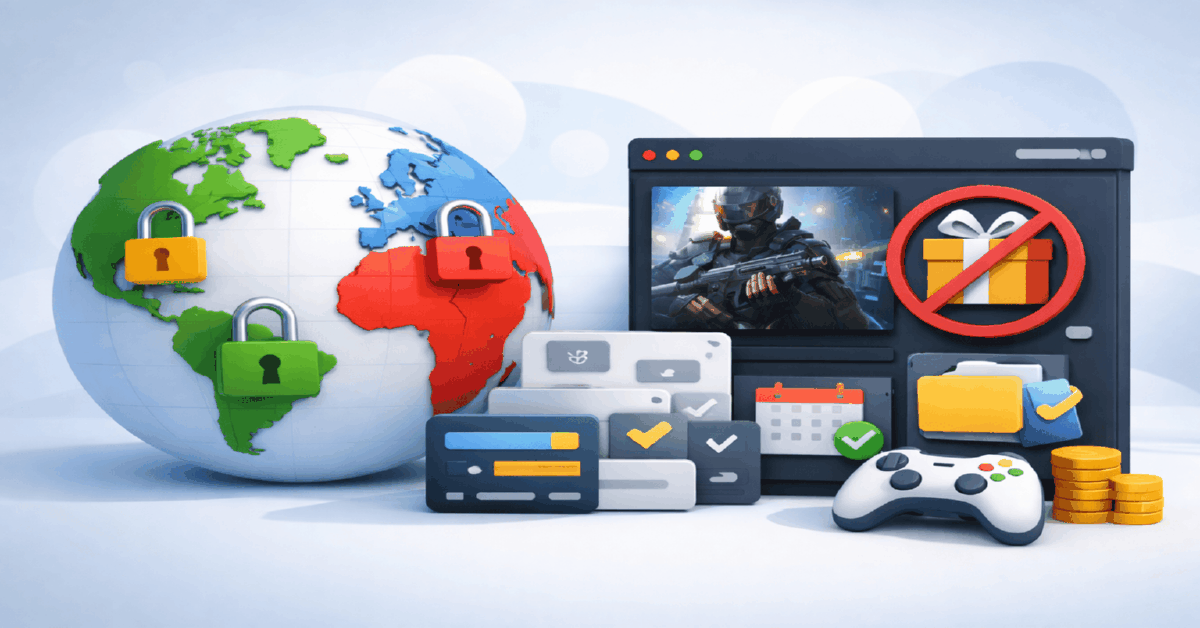


Summary:
- Launcher "region" is a rules bundle shaping currency, payment rails, catalog scope, and gifting/subscription/DLC limits.
- In 2026 it’s an operational risk for performance marketers: payment failures, blocked upgrades, churn in renewals, hard support disputes.
- Catalog gaps come from publisher licensing, local legal requirements, and platform compliance/pricing controls; visibility ≠ eligibility.
- Common failure modes: no page/search result; page exists but checkout is blocked; base game works while DLC is unavailable.
- Gifts are often stricter than self-purchases because platforms prevent cross-region price arbitrage.
- Most breakage sits in currency/payments: region changes may require a local billing instrument, throttling, and re-validation at renewals.
- Due diligence means testing repeatability (2nd/3rd transactions), mapping entitlement type (purchase/code/gift/subscription), and confirming support recoverability via email and proofs.
Definition
In a PC game launcher, a region is a policy state that sets store currency, payment eligibility, catalog availability, and rules for gifting, subscriptions, DLC, and in-game purchases. In practice you validate lifecycle repeatability: can the same account configuration buy again, renew, upgrade, top up, re-download, and recover via support without mismatched billing signals. This frames region choice as asset due diligence, not price chasing, especially for Russia and CIS in 2026.
Table Of Contents
- Regional settings in a game launcher are policy, not geography
- Why does a game exist in one region but disappear in another?
- Store currency and payments are where most purchases fail
- Can you change the account region without losing access?
- Different entitlement types have different regional locks
- What this means for buying accounts and maintaining access in 2026
- Under the hood: why platforms enforce regions so aggressively
- How to evaluate repeatable access with a marketer mindset
- What to do when a purchase fails after you already have access
Regional settings in a game launcher are policy, not geography
In modern PC ecosystems, a "region" is a bundle of rules that shapes your store currency, payment rails, catalog availability, and restrictions around gifting, subscriptions, DLC, and in game purchases. Two users can open the same launcher and see different prices, different game editions, and different purchase flows, even if they are looking at the same title. In 2026 this matters a lot for buyers who rely on predictable access over time, not just a one time download.
For performance marketers and media buyers, regional constraints are not a gamer niche detail. They are an operational risk that shows up as payment failures, blocked upgrades, churn in renewal cohorts, and support cases that are hard to resolve when account and billing signals do not match the user’s reality.
Why does a game exist in one region but disappear in another?
Because a store catalog is built at the intersection of publisher licensing, local legal requirements, and the platform’s own compliance and pricing controls. "Not available" can mean different things: the product is not listed, it is listed but not purchasable, it is purchasable but not giftable, or it is accessible only in specific editions. The practical outcome is that visibility and eligibility are separate states.
In day to day work, this creates a classic trap: a user can see a product page, complete a base purchase, then hit a wall on add ons or subscription renewal. That breaks lifecycle monetization and makes LTV assumptions unreliable if you do not model region rules upfront.
| Observed behavior | What it usually means | Where it hurts most | What to verify before you commit |
|---|---|---|---|
| No store page, no search results | Regional listing is disabled or hidden by distribution rights | Acquisition promises and landing pages mismatch reality | Confirm the catalog state for the account store region, not just your own view |
| Page exists, purchase is blocked | Sales restriction, billing restriction, or compliance gating | Checkout drop offs that look like "silent churn" | Test a repeatable checkout path with the same region currency and payment method |
| Base game works, DLC is unavailable | Separate regional rules for DLC and content entitlements | Upsell, retention, and post purchase revenue | Check DLC and subscription eligibility in the same store region |
| Gifting fails between accounts | Anti arbitrage controls on regional price differences | Team provisioning and partner transfers | Verify gifting policy for both sender and recipient store regions |
Expert tip from npprteam.shop, editorial team: "When a title vanishes or a button turns grey, don’t label it as a ban and move on. Identify which mode is restricted: listing, purchase, activation, gifting, renewal. Each mode fails differently, and the fix or workaround for one mode does not carry over to the others."
Store currency and payments are where most purchases fail
Most platforms bind store region to currency and payment eligibility. Region switches are commonly throttled, and some ecosystems require a local payment method to confirm the change. That creates a frequent mismatch: an account store region is set to one country, but the buyer’s payment instruments belong to another, so the purchase fails at checkout or later at renewal.
If you are running campaigns, this is the hidden leak in funnel analytics: users who cannot pay rarely file a ticket; they leave. The fix is to evaluate not only availability but repeatability, meaning the ability to purchase again, renew subscriptions, buy DLC, or complete in game transactions with the same account configuration.
How do you tell if the store region is tied to payment verification?
If region change is exposed inside the checkout flow, requires a local billing instrument, or is constrained by a cooling off period, the region is effectively anchored to the payments layer. In that setup, "it worked once" is not a guarantee. A later transaction can fail when the platform re validates billing signals or when a subscription renewal triggers a new authorization.
Can you change the account region without losing access?
In many ecosystems, previously purchased entitlements remain in your library, but future purchases operate under the new region rules. That includes currency, catalog scope, gifting eligibility, and subscription availability. The real risk is not losing the existing library; it is losing the ability to maintain it: re downloading, buying expansions, renewing subscriptions, or resolving disputes through support.
From an operations perspective, region change should be treated as a change in account policy state. If you manage assets across a team, the relevant question becomes whether the account can "live" without constant manual intervention when something breaks.
What typically breaks after a region switch?
The failures cluster around the money layer and the transfer layer. The money layer includes wallet balance tied to a specific currency, auto renewal, payment method re validation, and some in game purchase rails. The transfer layer includes gifting, sharing, and rules that prevent cross region price arbitrage. Support resolution can also become slower when purchase history, billing signals, and current access location do not align cleanly.
Expert tip from npprteam.shop, editorial team: "Treat region switching as a change in the account’s operating rules, not as a way to chase a better price. If your model depends on a second and third payment, validate renewals, DLC, and in game transactions first. Otherwise the ‘deal’ becomes an access token that fails at the first maintenance event."
Different entitlement types have different regional locks
A launcher can deliver access through multiple entitlement modes: direct store purchase, code activation, gifted license, subscription entitlement, DLC ownership, and in game currency or items. Each mode can be restricted independently. You can have a base game that launches fine, but DLC is blocked; a code that cannot be activated; a subscription that cannot be started in the current store region; or in game purchases that are disabled even while the game itself runs.
This is why "account with a game" and "code for a game" behave differently. One is tied to store policy at the moment of purchase; the other is tied to activation rules and distribution rights. For media buyers, the impact shows up post acquisition: users cannot complete monetizable steps even when initial activation succeeded.
Why is gifting often stricter than buying for yourself?
Gifting is a direct channel for exploiting regional price differences. Platforms protect regional pricing and publisher agreements by restricting gifts when regions diverge or when price gaps exceed policy thresholds. As a result, a plan that assumes "buy in region A, send to region B" routinely fails even when both regions can buy the same title for themselves.
What this means for buying accounts and maintaining access in 2026
If you treat an account as a digital asset, region rules are part of its technical condition. An asset has a store region, currency state, payment history signals, region switch limits, gifting constraints, subscription eligibility, and support recoverability requirements. A good price is not a substitute for a stable lifecycle.
The most common failure pattern is "works on day one, breaks later." The later event can be a subscription renewal, a DLC purchase, a wallet top up, a verification prompt, or a support interaction after a lockout. If the buyer cannot reproduce the payment path or cannot prove ownership signals, the asset becomes fragile.
| Pre purchase checkpoint | What to capture | Why it matters | Typical risk if skipped |
|---|---|---|---|
| Store region and currency | Country setting, displayed currency, wallet behavior | Defines eligibility for checkout and renewals | Access exists, maintenance fails |
| Entitlement mode | Store purchase, code activation, gift, subscription | Different locks apply to each mode | Game runs but expansions and upgrades are blocked |
| Gifting and transfers | Cross region gift restrictions for both parties | Teams often rely on transfers implicitly | Provisioning breaks, disputes escalate |
| Support recoverability | Email control, purchase proofs, billing history access | Disputes are decided by evidence trails | Lockout becomes permanent |
Under the hood: why platforms enforce regions so aggressively
Platforms enforce regions because otherwise regional pricing and distribution contracts collapse. There are a few engineering and policy drivers that explain most of the seemingly random restrictions.
First: regional pricing is not just currency conversion. It is a policy layer shaped by local taxes, processing fees, consumer purchasing power assumptions, and publisher strategy. Uncontrolled cross region buying creates price arbitrage, and publishers respond by removing regional discounts or restricting distribution.
Second: gifting and activation are the highest risk vectors. That is why those modes often have stricter checks than a direct purchase. It is cheaper for a platform to deny suspicious transfers than to resolve large volumes of support cases and chargebacks.
Third: payment instruments are a low friction way to validate region. Document checks and manual verification are expensive and create support friction. A local billing method provides a scalable signal, so platforms lean on it heavily.
Fourth: distribution rights differ by territory. The same title can have different publishers, different editions, and different licensing terms across regions. That is why a product can exist as a page but remain blocked for purchase or for specific add ons.
How to evaluate repeatable access with a marketer mindset
For a practical framework, think in terms of lifecycle steps: install and re download, base purchase, DLC upgrade, subscription renewal, in game purchase, gift transfer, support recovery. The asset is stable only if these steps are repeatable under the account’s store region and currency rules.
This is where performance marketing meets platform policy. If your revenue model depends on retention and recurring spend, region constraints can invalidate your assumptions quietly. The clean approach is to validate the second and third transaction paths early, not after the user is already acquired.
| Lifecycle action | Dependency | What you are really testing | What failure implies |
|---|---|---|---|
| Renew a subscription | Region currency, payment re authorization | Repeatability of billing under region policy | Account is usable but not sustainable |
| Buy DLC | Catalog scope and content licensing | Whether add ons follow base entitlement rules | Upsell is structurally limited |
| Top up wallet or buy in game items | Payment rails and store policy | Monetization after acquisition | Post purchase revenue is capped |
| Recover access via support | Email control and proofs of purchase | Recoverability of the asset under disputes | One incident can kill the asset |
What to do when a purchase fails after you already have access
When checkout fails or DLC becomes unavailable, the first step is to identify the restricted mode. Is the issue a catalog rule, a payment rule, a currency rule, a gifting rule, or an entitlement type rule. The same title can be accessible but not purchasable, purchasable but not upgradeable, upgradeable but not renewable. Once you map the mode, you can interpret the failure as either a transient payment issue or a structural region policy mismatch.
For teams operating across Russia and CIS, the critical takeaway is operational: treat region settings as part of asset due diligence. A stable library today is useful, but a stable lifecycle is what protects budget and time tomorrow.

Facebook Ads Test Campaigns 2026 - Practical Guide
Launching Test Campaigns in Facebook Ads Manager in 2026: what actually works without burning budgetNew to the ecosystem? For context...

How to adapt offers for the TikTok mobile audience?
Why adapt offers specifically for TikTok’s mobile audience?Decisions in TikTok happen in 3–7 seconds, one-handed, on a vertical screen; your...

How do I choose a channel theme if I'm starting from scratch?
If you’re starting from scratch and want to build a channel around TikTok Ads, you shouldn’t pick a topic by...


